Wedge distance chart: average yards by loft, plus how to find yours.
PW ~110 yd, GW ~95 yd, SW ~80 yd, LW ~65 yd for a mid-handicap. Here's how to find your own numbers and tighten the gaps between wedges.

What a wedge is, and why loft matters.
A wedge is any club between about 44° and 64° of loft — built for scoring inside roughly 130 yards. The loft is what does the work. Higher-lofted clubs launch higher, carry shorter, and stop faster on the green. Lower-lofted wedges fly lower, run more, and reach farther on a full swing.
Most golfers carry three or four wedges that step down the loft ladder in 4° to 6° gaps. That spacing is what makes the yardage gaps between them feel natural. Skip a gap and you'll find yourself stuck between clubs on the most important shots of the round.
For the full setup conversation — which lofts to carry, the matched Compete Wedge Set, and whether to buy a single wedge or the three together — see the complete wedge guide.
What actually changes your wedge yardage.
Five things move the number more than anything else. Knowing which one is responsible for a given shot is half the battle.
Swing speed.
The biggest single driver. Faster clubhead speed means more ball speed, which means more carry. A 56° wedge that flies 90 yards for a 100-mph swinger goes about 75 for a 85-mph swinger, all else equal.
Strike quality.
Catch the ball thin and you lose 8–15 yards. Catch it fat and you lose more. Where the ball sits on the face matters too — toe and heel strikes leak distance even when contact feels clean. Repeatable strike position is what makes wedge distance consistent.
Loft and bounce of the club.
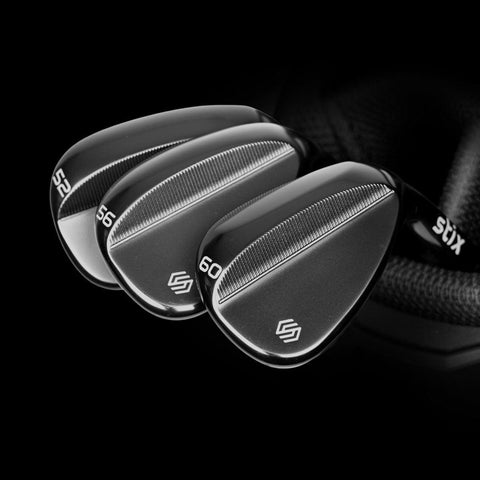
Two wedges that say "56°" on the head can fly differently. Bounce angle, sole grind, and groove sharpness all affect launch and spin. The Compete Wedge Set uses a milled face on a 431-stainless head with sole grinds tuned to each loft — full sole on the 52°, double sole on the 56° and 60° — so the yardage gaps stay predictable.
Turf and lie.
Firm turf produces a cleaner strike and a more predictable number. Soft, wet, or fluffy lies kill ball speed. Long rough adds gear effect and reduces spin. Bunker sand is its own category — there, you're not playing for a number, you're playing for a result.
Air and elevation.
Cold air is denser and shortens carry — roughly 1 yard per 10°F below 75°F. Wind moves wedges more than people expect because the ball is in the air longer than a low-flying iron shot. Elevation cuts both ways (less air, easier carry; but the trajectory looks unfamiliar).
Loft is what you control. Everything else is conditions.
The wedge distance chart.
Below are full-swing carry yardages for a typical mid-handicap golfer (10–18 handicap). Lower handicaps and faster swing speeds run 10–20 yards longer per wedge; slower swings run 10–20 yards shorter. Use this as a starting frame, then measure your own — instructions in the next section.
| Wedge | Loft | Full-swing carry | Three-quarter carry |
|---|---|---|---|
| Pitching Wedge (PW) | 44°–48° | 110–135 yd | 85–105 yd |
| Gap Wedge (GW) | 50°–52° | 90–110 yd | 70–85 yd |
| Sand Wedge (SW) | 54°–56° | 75–95 yd | 55–75 yd |
| Lob Wedge (LW) | 58°–60° | 60–80 yd | 40–60 yd |
Numbers are carry distance (not total). Roll-out varies by green firmness and spin. Women golfers run roughly 15–25 yards shorter per club; tour-level swing speeds run 15–25 yards longer.
How to measure your real numbers.
The chart above is a starting frame. Your own numbers are the only ones worth playing to. Here's how to build a personal distance chart in five steps.
- Use a launch monitor if you have access. A range with a Trackman, GCQuad, or even a SkyTrak gets you ten shots' worth of carry data per club in fifteen minutes. Throw out the worst two and the best one. The remaining seven are your real number.
- No launch monitor? Head to a marked range. Find a range with yardage flags at known distances. Hit ten balls with each wedge, walk out to the cluster, average the carry. Write it down. Wind matters — measure on a calm day or average across two sessions.
- Take your notes on the course. Range numbers are usually 5–10 yards longer than course numbers because range balls fly differently. Confirm by hitting wedge shots to known yardages on the course over a few rounds.
- Track partial swings. The three-quarter swing column above is the most-used wedge distance in actual rounds. Measure your 3/4 swing carry for each wedge — that's the number that controls scoring.
- Log your final distances. Write them on a sticker on your bag or in your phone. Update once a season as your swing changes.
How to tighten up your distance control.
If your wedges are inconsistent, the fix is rarely "swing harder." It's usually one of three things.
Get the gaps right first.
Most amateurs carry a 44° PW, a 56° SW, and nothing in between — a 12° gap that creates a 25-yard hole in their bag. Adding a 50° or 52° gap wedge solves more scoring shots than any range session. The matched 52° + 56° + 60° Compete Set is built to give you even spacing across the loft ladder.
Practice partial swings, not full swings.
Real wedge shots are almost never full swings. Build feel for the 3/4 swing and the 1/2 swing on each wedge. The carry distances on those swings are what you'll use on the course.
Get serious about strike.
A clean center-face strike on a 56° wedge produces a predictable number. A toe or heel strike produces a 10-yard miss in either direction. Foot spray on the face during practice shows you exactly where you're contacting the ball. Fix the strike, the number takes care of itself.
Common wedge mistakes to avoid.
Three patterns cost amateurs the most strokes inside 130 yards.
Hitting full-swing wedges when a 3/4 swing fits the yardage. Full swings introduce more variables — bigger weight shift, longer arc, more strike risk. If a 3/4 swing covers the number, take it.
Carrying the wrong four wedges. A PW + 56° SW + 60° LW with no gap wedge leaves a hole. A PW + 50° + 54° + 58° + 62° is too many wedges and you're giving up a long iron or hybrid you need. Three wedges spaced 4–6° apart fits most golfers.
Using a 60° lob wedge before you're ready. The 60° is the least forgiving wedge in the bag. Most amateurs benefit more from a 56° as their highest wedge until their short game is repeatable. Add the 60° later.
Final thoughts.
Wedge distance isn't about adding yards. It's about removing surprises. Know the gaps between your clubs, know your own carry numbers for each, and the scoring shots inside 130 yards stop feeling like guesses.
The starting point: read the wedge loft guide if you're still deciding which lofts to carry, see the complete wedge guide for set-vs-single decisions, or browse the Compete Wedge Set if you're ready to lock in the 52°/56°/60° setup.
Distance control on a wedge isn't a swing-harder question. It's a pick-the-right-loft question. The bag setup does the work.
Frequently asked questions
How far should you hit a 56 degree wedge?
What's the average distance of a pitching wedge?
How far does a gap wedge go?
Are wedge distances different for women?
How do I measure my wedge distances?
Related Stix sets — built around the configurations described in this article.